
Force, motion & position sensors
LVDT transducers
Measure movement and position with precision
LVDTs (Linear Variable Differential Transformer) are robust and high-precision transducers used to measure linear displacement, motion and position in industrial environments. They are used in everything from automated production lines and laboratories to demanding processes such as marine and defence applications.
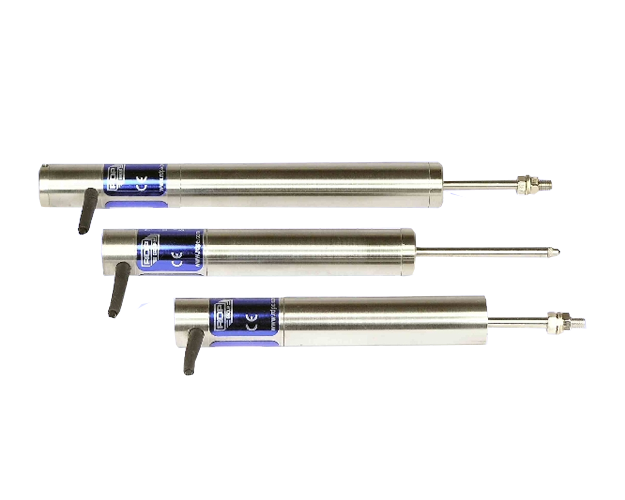
With LVDT sensors you get:
- Very high accuracy and linearity
- Extremely long life and robust construction
- Flexible installations for dry, wet and humid environments
- Choice of different mechanical types: unguided, captive guided, spring return, air push or non-contact
- Wide measuring range and temperature range
Everything you need to know about LVDTs
- Environment: Select sensor by environment: dry, wet, submersible or seawater.
- Signal output: LVDT transducers require a signal conditioning amplifier, either internal (DC, 4-20 mA) or external. Digital display can be added.
- Mechanical type:
- Unguided - no physical contact, minimal wear, extremely robust
- Captive guided - inner bearing provides support for minor misalignments
- Spring return - spring returns the luminaire, good for large movements
- Air push - the luminaire is moved by air pressure, useful for moving targets
- Non-contact - measures distance without physical contact with the target - Measurement area: Choose the exact linear distance to be measured for optimal accuracy.
- Temperature: LVDT sensors can be used in most industrial temperatures. External amplifiers increase the ability to measure in extreme heat or cold.
- Radiation: Standard LVDTs can cope with normal industrial levels. For high radiation levels, LVDTs without internal amplifier are used with external amplifier placed away from radiation.
- Robustness: Stainless steel housing protects against mechanical damage, shocks and electromagnetic interference. Unguided versions have no contact between luminaire and housing, eliminating wear and tear.
- Accuracy: Hysteresis and repeatability are close to zero on unguided versions. Linearity error is typically ±0.5 % of full scale with possibilities of ±0.25 % and ±0.1 %.
Frequently asked questions (FAQ)
What is an LVDT transducer?
- An LVDT (Linear Variable Differential Transformer) measures linear displacement and provides an electrical signal proportional to the position of the luminaire.
What environments can LVDTs be used in?
- Dry, wet, seawater and extreme temperatures - the choice depends on the model and enclosure used.
Does the LVDT need external electronics?
- Yes, LVDT is a transformer and requires signal processing. This can be done via internal or external amplifier, with the option of 4-20 mA, DC or digital display.
How robust is an LVDT?
- LVDT transducers are very robust thanks to stainless steel housing, stable windings and minimal moving contacts