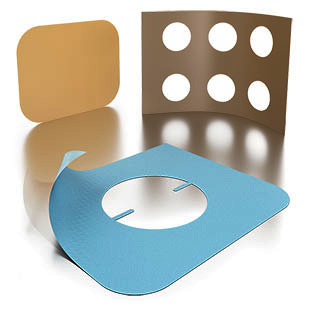
Thermal Interface Materials (TIM)
Efficient heat dissipation without moving parts
TIMs improve heat transfer between two surfaces by filling microscopic air gaps. They are used in conjunction with other cooling methods to enhance heat dissipation. There are different types of thermal interface materials (TIM) to meet the requirements of the application.
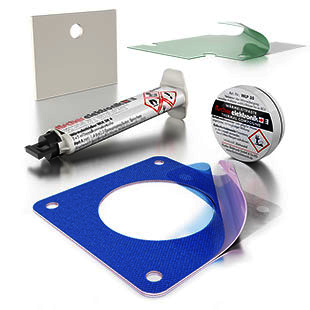
When contacting two flat surfaces that need to be thermally connected, such as a transistor and a heat sink or chassis, the effective contact area is only 2-5 %. The rest of the surface consists of an air cushion. Air is a very poor conductor of heat and significantly hinders heat transfer. To improve heat transfer, materials are used that fill the air and are thermally conductive, such as pastes or thermally conductive foils. Thermally conductive foils are particularly recommended when, in addition to good heat conduction, the material also needs to provide electrical insulation.
The type of thermally conductive foil used depends on the specific application. It can also provide a simple insulation in addition to bridging gaps (gap-filler). Thermally conductive foils, also called Thermal Interface Materials, can be based on silicone elastomer or other materials, and can have durable or adhesive coating. They are available in different thicknesses and designs. Swelex thermally conductive foils are particularly suitable for efficient heat dissipation. The company offers different materials, thicknesses and designs according to industry standards; from silicone foil in standard sizes, adapted to different component sizes such as transistors, to gel, foam or polyimide foil. The film can also be supplied as customised cuts for specific applications.
Thermal conductivity is measured in W/(m-K). Watt per metre and Kelvin (W/mK) is a unit of thermal conductivity of a material, often denoted as lambda (λ). It indicates how efficiently the material conducts heat: a lower value means better insulation and less heat conduction, which is desirable in building materials. A higher W/mK value means that heat is more easily transported through the material.
What it means in practice
- W (Watt): Measures the power, i.e. the amount of energy (heat) transferred.
- m (metres): Indicated per metre (thickness).
- K (Kelvin): Indicates the temperature difference, one degree difference in Kelvin is the same as one degree difference in Celsius.
Examples of different types of TIM:
- Thermal pads - gap pads, purchased in sheets or in customised dimensions, easy to install and suitable for automated assembly. Available in different thicknesses, hardnesses, thermal conductivity, UL94V0 approved, available with adhesive, etc.
- Thermal grease/paste - bought in a jar or in a syringe. Easy to use.
- Phase change material (PCM) - Phase Change Material (PCM), changes under temperature differences. Softens with heat and adapts to surfaces.
- Gap fillers - heat conductive foam and gel, soft and compressible for larger or uneven gaps
- Graphite sheet - excellent lateral heat dissipation. Withstands high heat.
- Thermally conductive adhesive - epoxy-based adhesive filled with aluminium oxide. Easy to use. Packaged in different sizes.
Graphene-enhanced TIM
Graphene-enhanced TIM is an advanced solution where graphene is integrated into traditional materials to dramatically improve thermal conductivity.
They are light, flexible and chemically stable.
Contact Swelex
Contact Swelex for advice and a quote - we are happy to help you!